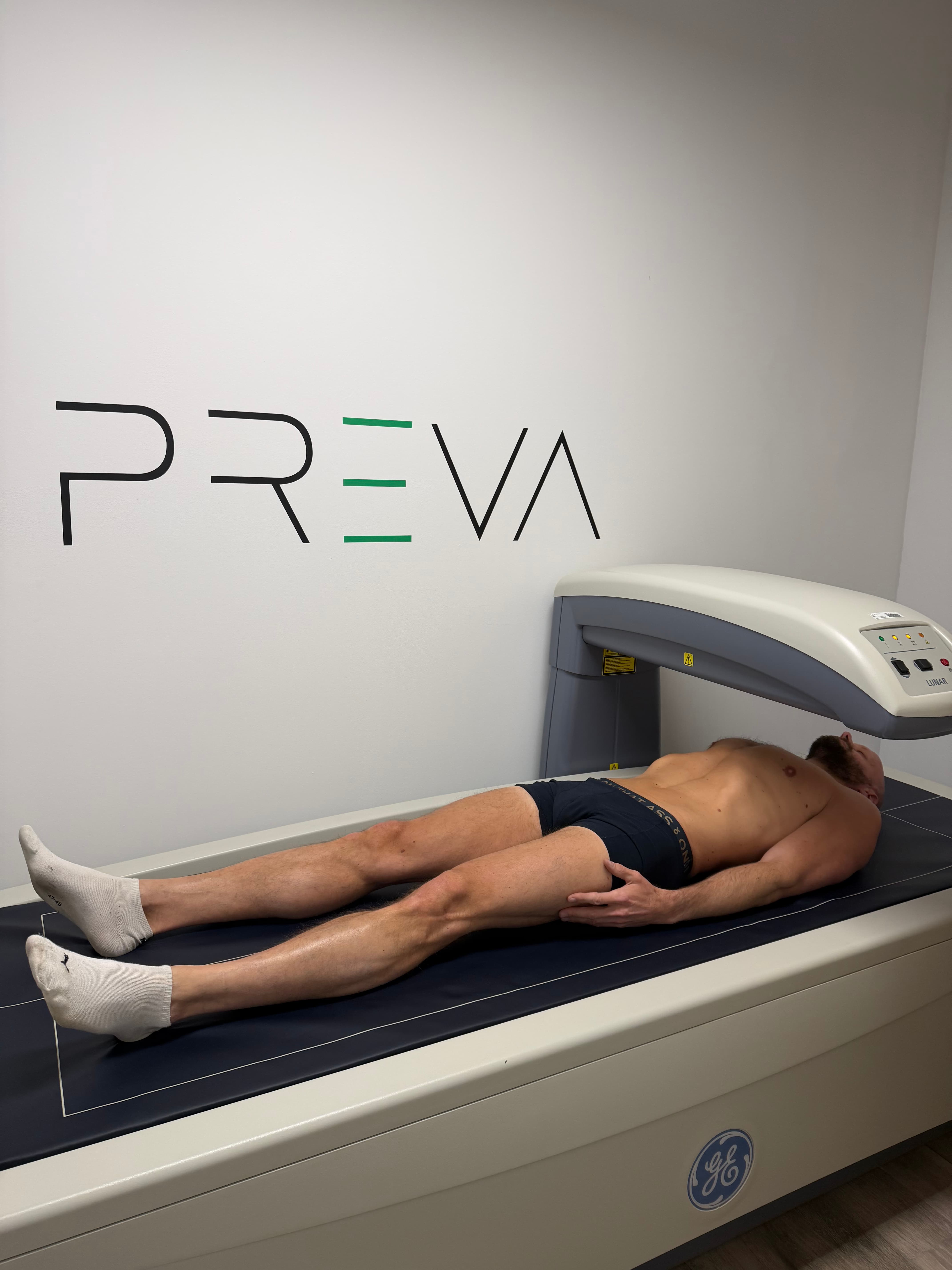
Today I was on a DEXA machine at Preva in Mol. Ten minutes of lying still while an X-ray beam moved over my body. The report that came out: 7.1% body fat.
Yesterday I stood on my Fitdays scale at home. It said 10.8%.
That's a difference of 3.7 percentage points. On an 85-kilo body, that's about 3 kilos of fat mass the two machines disagree on. Three kilos is a human head full of uncertainty.
Which one is right? Both. And neither. Let me explain.
What BIA actually does
A BIA scale — even if it costs €300 like mine — doesn't measure fat. It measures resistance. A small current runs up through your feet, and the scale looks at how quickly it comes back. Fat conducts poorly, muscle and water conduct well. From that difference, a formula estimates how much fat you have.
That formula is built on averages — based on thousands of people. If you're average, it's fairly accurate. If you're not average — athletic, lean, dehydrated, just trained, just eaten — it falls out of step.
My Fitdays consistently overestimates my fat by 3-4%. Always. Every day. I know that now. But you don't discover that by staring at the scale — you discover it by putting a DEXA next to it.
What DEXA does instead
DEXA is the gold standard. Two different X-ray beams separate your body into three components: bone mass, fat mass, lean mass. No estimates based on conductivity — actual density measurement.
My results:
- Fat: 6.1 kg (7.1%)
- Lean: 76.7 kg
- Bone: 3.4 kg (T-score 0.6 — solid bones)
- A/G ratio: 0.95 — a slight tendency toward the belly, but healthy
Those are numbers I'm happy with. Honestly.
But DEXA lies sometimes too.
A small detour: this cost me €25
Not €200. That's what DEXA scans cost on average in the Netherlands, and that's probably why most people never get one. In Belgium it's a different story. At a multidisciplinary practice like Preva, DEXA is simply part of the offering — alongside dietetics, podiatry, speech therapy. For €25.
For anyone from the Netherlands crossing the border: fill up your tank in Belgium on the way back. The price difference with the Netherlands easily saves €15-25 on a full tank. The scan has paid for itself before you're home. The only real cost is your time.
Why do I mention this? Because it means DEXA is a feasible annual measurement for far more people than they think. Not once out of curiosity, but a benchmark you can repeat every 6-12 months. That changes the game.
The limits of DEXA
Hydration. When I'm well hydrated, DEXA measures more "lean mass." When I show up to the scan dehydrated — like this morning, because I'd just had a training day — it measures less. A difference of 1-2 liters of water can move your BF measurement by 1%.
Clothing, position on the table, whether my hands were against my thighs or next to them — all things that affect the scan. And DEXA machines from different brands give different results. A Lunar scan (like mine) consistently reads 1-2% lower than a Hologic.
So even "7.1% on DEXA" isn't the truth. It's an accurate estimate at one specific moment, with one specific machine, at one specific hydration status.
And then the mirror
I looked in the mirror this morning. Upper four abs visible, serratus starting to show, vascularity in the forearms. But the full six abs — those bottom two every man looks at — aren't there yet. I saw a body that's lean, not one that's "done."
The mirror lies too.
When I'm tired, when I've just woken up, when the light falls wrong, when I've just eaten, when I've got a pump from the gym — the image changes. The same body can look like 8% in the morning and 11% in the evening. That's called visual BF% and it's a biased measuring instrument that serves my own brain.
Body dysmorphia is the extreme version of that. People see themselves as fatter than they are. Or thinner. Or — in bodybuilder circles — never muscular enough. The mirror can be an honest guide or a tool for sabotage, depending on your mental state that day.
The thing I only realized tonight
My 100-day cut had 9% BIA as its goal. Translated into what I wanted to see in the mirror: a full six-pack. I thought those two were the same.
They're not.
For most men, the full six-pack isn't at 9% BIA, but at 5-5.5% DEXA. Upper four abs visible? Those show up around 7% DEXA — where I am now. The bottom two only come once that last 1.5-2% is gone. That's not failure, that's anatomy.
So the real picture isn't "goal reached, done." It's: I spent five months looking at the wrong number. My BIA gave me 9% as the destination; DEXA shows that 5% is the destination — and that I'm closer to it than I thought.
I still had 1.8% BIA to go. That felt like 75 days of grinding. In reality I have 1.5 kg of fat left to lose on DEXA. That's 6-8 weeks, not 75 days.
The measuring instrument wasn't wrong. The benchmark was wrong.
The measuring instrument wasn't wrong. The benchmark was wrong.
What does matter
Three data points: Fitdays, DEXA, mirror. None of the three tells me the whole truth. But together they form a more honest picture than any one of them alone.
And here's what actually tips the balance: how I feel.
- I sleep deeply.
- I have energy when I wake up.
- My workouts are getting stronger, not weaker.
- My mood is stable.
- My wife says I look sharp.
- My clothes fit differently. Pants that were tight three months ago are loose now.
That is the real dashboard. The numbers are useful as input, but the output that counts is how your body and your head feel.
In the past I've had phases where the scale was "good" but I felt bad — tired, grumpy, every workout a struggle. That's not success. That's a body protesting while a number pretends everything is fine.
How my journey has been adjusted
The old plan: cut for 100 days, peak around July 5, recover. Linear. One phase, one end date, one goal.
The new plan, based on the DEXA data and the calendar:
Phase 1 — Reverse diet (April 22 - May 18, 4 weeks) No more cutting. Calories gradually up from ~2500 to ~2950. Keep protein high (200g) for muscle memory recovery. Goal: restore metabolism, normalize leptin, take advantage of muscle growth in this lean state. Expected weight: 85 → 87 kg, mostly glycogen and muscle.
Phase 2 — Summer cut (May 19 - July 15, 8 weeks) Short, sharp cut to 5.5-6% DEXA. Peak on July 13-15. Starts during the Poland trip (June 5+). This cut is more aggressive than the first, but shorter, and from a rested base. Goal: the bottom two abs.
Phase 3 — Post-peak reverse (July 16 - August 12) After the peak, gradually back up to maintenance. Hormonal recovery. Weigh in 2-3x per week to prevent BDD.
Phase 4 — Natural lean growth (August 13 - October 31) No more supplements. Steady lean bulk to 89 kg, BF% between 9-11%. Bloodwork in mid-August. Muscle growth without the cut mentality.
Formari shifts along with it. Macro targets, step goals, training schedule, milestones — everything automatically moves from cut mode to reverse mode. Not because I entered that by hand, but because the system detects that the phase goal has been reached and starts the next phase.
Not everything worked 100% automatically today. I found a few bugs in the phase-transition logic precisely because I entered my own DEXA. That's the advantage of being your own first user: you see where it creaks. Those fixes are on the list.
The principle does stand: no single measuring instrument gets the last word, and how you feel is always a measurement.
What now
My 100-day cut ends today, on day 25. Not because I failed. Not because I'm "done." Because I've been given a better compass, and that compass says: the route to the real goal is shorter than you thought, but you have to take a different exit.
So: reverse instead of cutting on. Gaining muscle mass instead of losing it. And then in July, when it's summer, the last 1.5% off for the full six-pack. One short cut, at the right moment, starting from a stronger body.
That's a better strategy than I had without the DEXA.
Three things to take with you:
No single measuring instrument tells the whole truth. Not your scale. Not the DEXA. Not the mirror. Use them all, trust none of them blindly.
How you feel is the real signal. Sleep, energy, mood, training performance, how your clothes fit. Those aren't soft numbers — they're the output metrics the rest is meant for.
The benchmark matters more than the measuring instrument. A perfect measurement against the wrong goal is still the wrong goal. DEXA didn't just give me a more accurate number, it gave me a more accurate destination.
Today both add up. That's nice. But I'll keep checking them, because bodies change and dashboards lie.
Scanned at Preva — Mol
The DEXA for this blog was done at Preva, Turnhoutsebaan 301 in Mol. A multidisciplinary practice: dietetics, DEXA scanning, speech therapy, podiatry, child psychology, occupational therapy — all under one roof. When I told them what I was building with Formari, they were enthusiastic and thought along with me. Thanks for that — and if you want a reliable body composition scan near Mol: here's the address.
Rob
Try Formari
Formari is currently in private beta. Want to be one of the first to get access?